
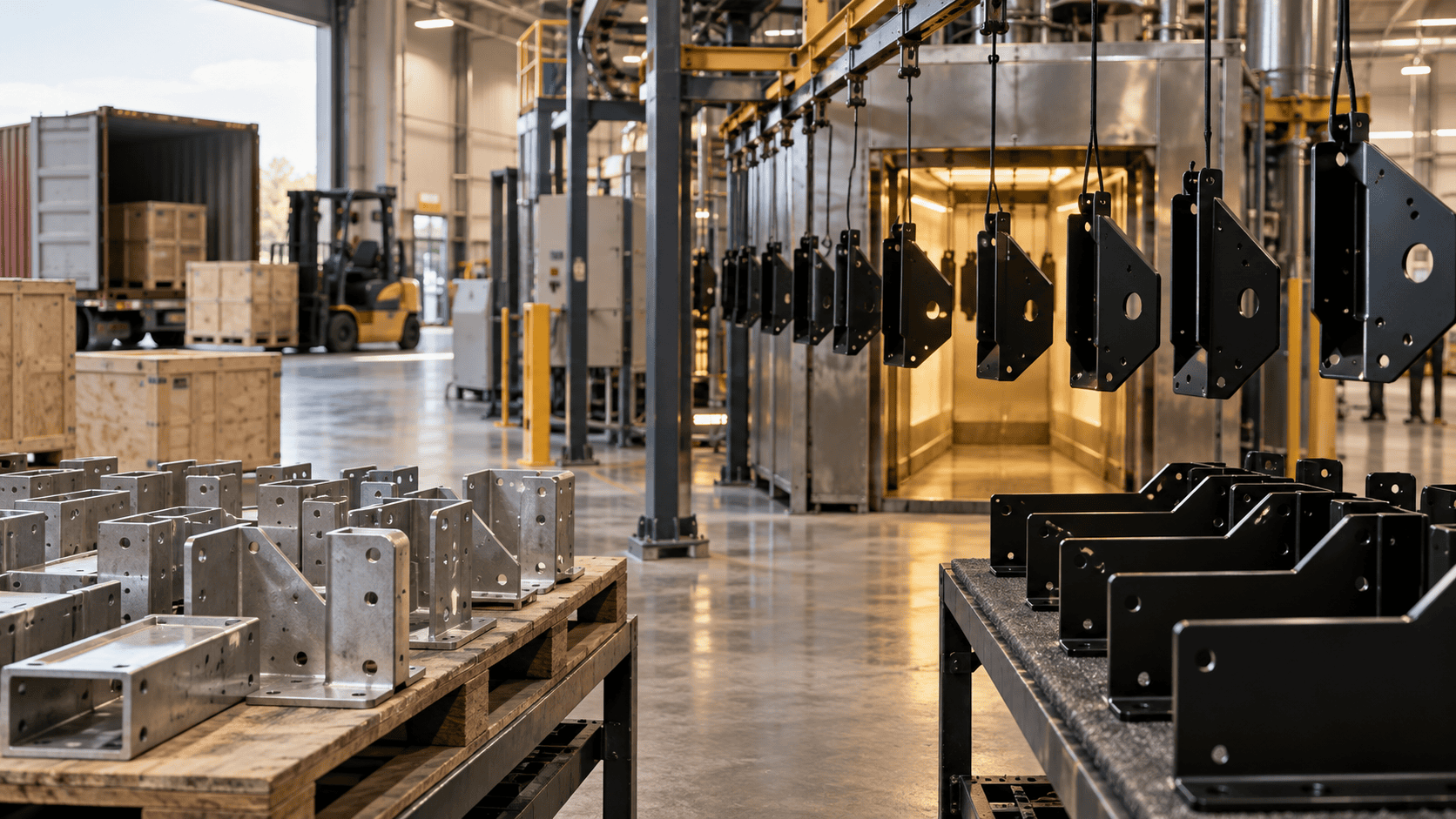
Moving metal finishing to the United States can help an international manufacturer become more responsive to U.S. customers, shorten parts of its supply chain, and potentially reduce certain tariff and transportation exposures.
However, placing coating or finishing work in the United States does not automatically change a product’s country of origin or eliminate import duties. Before making the move, a manufacturer should evaluate two tracks at the same time: the customs, tariff, and country-of-origin consequences, and the practical ability of a U.S. finishing partner to reproduce the required finish at production scale.
Addressing both tracks early can prevent an attractive reshoring plan from creating new cost, quality, or compliance problems.
1. Determine Exactly What Will Move to the United States
Start by defining which portion of the manufacturing process will occur domestically. Will the company import unfinished metal components, partially manufactured assemblies, fully manufactured products needing only a final coating, or raw materials that will undergo additional U.S. manufacturing?
That distinction affects freight, inventory, production planning, customs treatment, and the amount of value added in the United States. It also determines what the domestic finishing company must be prepared to receive, process, inspect, package, and release.
2. Verify Tariff Classification and Country of Origin
A product’s U.S. tariff treatment begins with its classification under the Harmonized Tariff Schedule. The classification used by a foreign supplier is not necessarily the correct U.S. classification, so it should be verified for the actual product being imported. The U.S. International Trade Commission maintains the current Harmonized Tariff Schedule.
Manufacturers should also determine whether the proposed U.S. operations will affect the product’s country of origin. In some circumstances, origin can change when processing produces a sufficiently substantial transformation. This is a product- and fact-specific determination—not an automatic result of performing coating, assembly, or another operation in the United States. The Department of Commerce provides an overview of the substantial-transformation standard.
A company should not assume that domestic finishing alone will make a product eligible for a “Made in USA” claim. The Federal Trade Commission’s U.S.-origin guidance applies separate substantiation requirements to those claims.
When tariff exposure or origin treatment is material to the decision, the company should consult a qualified customs adviser. It may also request a prospective binding ruling from U.S. Customs and Border Protection concerning classification, origin, marking, or other import questions. CBP explains its binding-ruling process here.
3. Define the Complete Finishing Requirement
A domestic finisher cannot reliably quote or reproduce a process based solely on a color name or a previously finished sample. The manufacturer should supply the information needed to define the finished product, including:
- Part drawings, dimensions, weights, and annual quantities
- Substrate and material condition
- Required cleaning and pretreatment
- Coating specification, manufacturer, color, gloss, and texture
- Masking, plugging, grounding, or no-coat areas
- Service environment and performance requirements
- Appearance standards and acceptable variation
- Inspection, testing, and documentation requirements
- Packaging and handling expectations
These details help the finishing partner determine whether its pretreatment, equipment, ovens, fixtures, inspection methods, and production capacity are appropriate for the work.
4. Prove the Process With a Pilot Run
A pilot run should be completed before transferring regular production. It allows both companies to confirm part preparation and handling; racking, masking, and fixture requirements; coating appearance and coverage; cure conditions and repeatability; inspection standards; packaging; production time; and achievable throughput.
Approval should be based on agreed criteria, not merely on whether the first parts “look good.” Fixtures, approved samples, process instructions, photographs, and inspection records should become part of the production standard.
5. Evaluate the Complete Operating Cost
The lowest coating price does not necessarily produce the lowest operating cost. A complete evaluation should include international and domestic freight, customs duties and brokerage, packaging, inventory held in transit, batch requirements, lead-time variability, rework, communication delays, expedite costs, and working capital tied up in inventory.
Domestic finishing may create value through shorter replenishment cycles, easier communication, faster problem resolution, and reduced dependence on congested ports or vulnerable international shipping lanes. Those advantages should be included in the decision—not treated as incidental benefits.
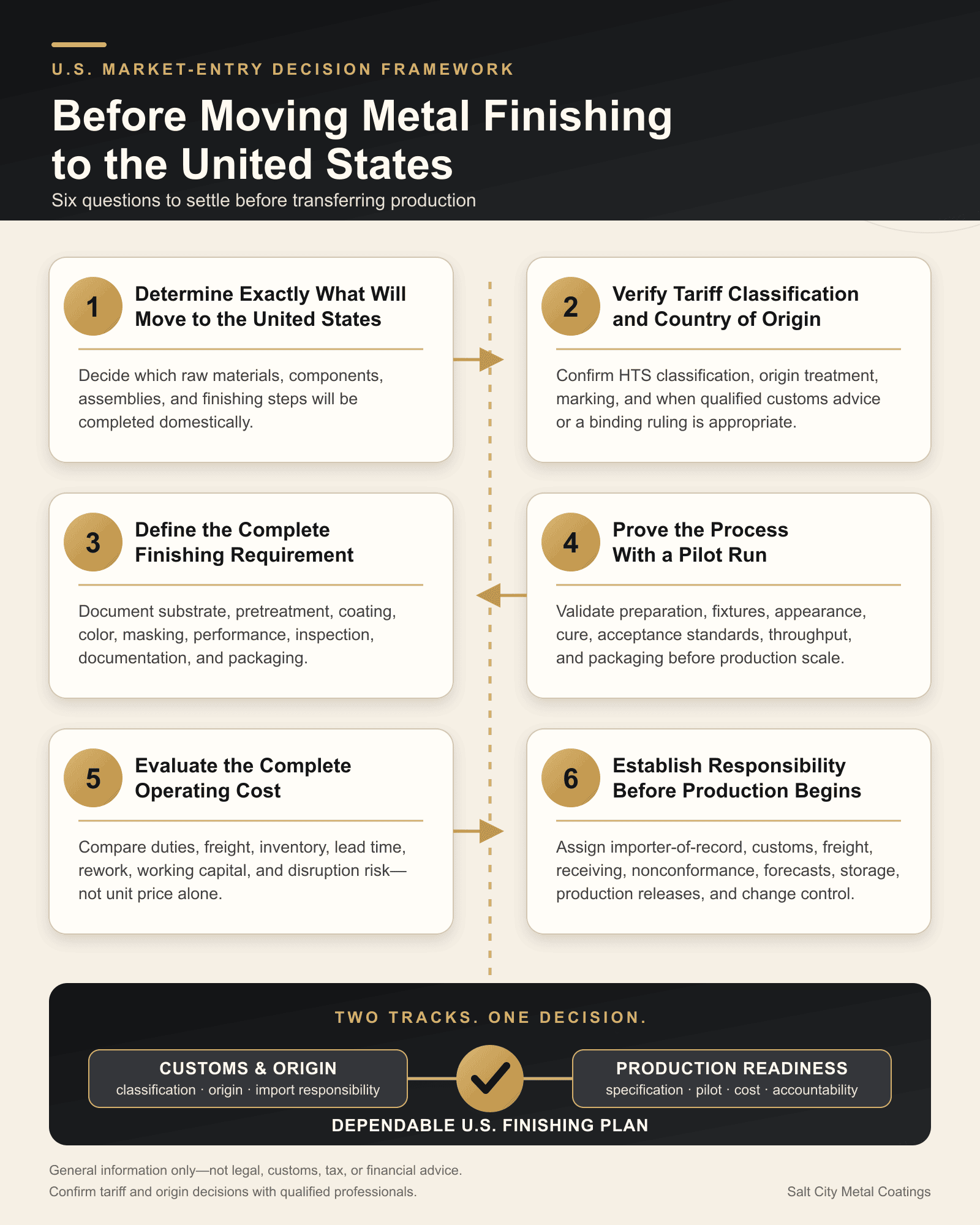
6. Establish Responsibility Before Production Begins
The international manufacturer and its U.S. partners should agree on who will manage importer-of-record obligations, customs documentation, freight, receiving inspection, nonconforming material, forecasts and release schedules, finished-product storage, packaging, outbound transportation, and engineering changes.
Foreign companies considering a broader U.S. presence can also consult the Department of Commerce’s SelectUSA Investor Guide for information about business structure, taxes, workforce, site selection, incentives, and other market-entry considerations.
A Pre-Transfer Checklist
- What is the correct U.S. tariff classification?
- What will the product’s country of origin be after the proposed U.S. operations?
- Who will serve as importer of record and manage customs compliance?
- Which manufacturing and finishing steps will occur in the United States?
- Can the finishing partner accommodate the parts, specifications, volume, and schedule?
- Has the process been proven and documented through a pilot run?
- Are inspection and acceptance standards clearly defined?
- Have logistics, packaging, inventory, and total operating cost been evaluated?
How Salt City Metal Coatings Can Help
Salt City Metal Coatings has experience helping international manufacturers establish U.S.-based finishing as part of a broader onshoring or U.S. market-entry plan.
We can review part drawings, coating requirements, quantities, packaging needs, and production timing; determine whether our equipment and processes fit the application; and develop a controlled pilot before regular production begins.
We do not provide customs or legal advice, but we can work alongside a manufacturer’s customs, logistics, engineering, and operations professionals to help translate an approved plan into a dependable domestic finishing process.
For the broader supply-chain perspective, read How Domestic Metal Finishing Can Reduce Supply-Chain Risk.
Important tariff and customs notice: Salt City Metal Coatings provides metal-finishing and production support—not legal, customs, tax, or financial advice. Tariff classification, duty exposure, country of origin, marking requirements, trade-program eligibility, and “Made in USA” claims depend on the specific product, transaction, manufacturing process, and current law. Confirm these matters with qualified customs, trade, legal, and tax professionals before making sourcing or investment decisions.
If you are evaluating U.S.-based powder coating or metal finishing, visit our Supply Chain Support page or request a quote to begin a confidential project review.