
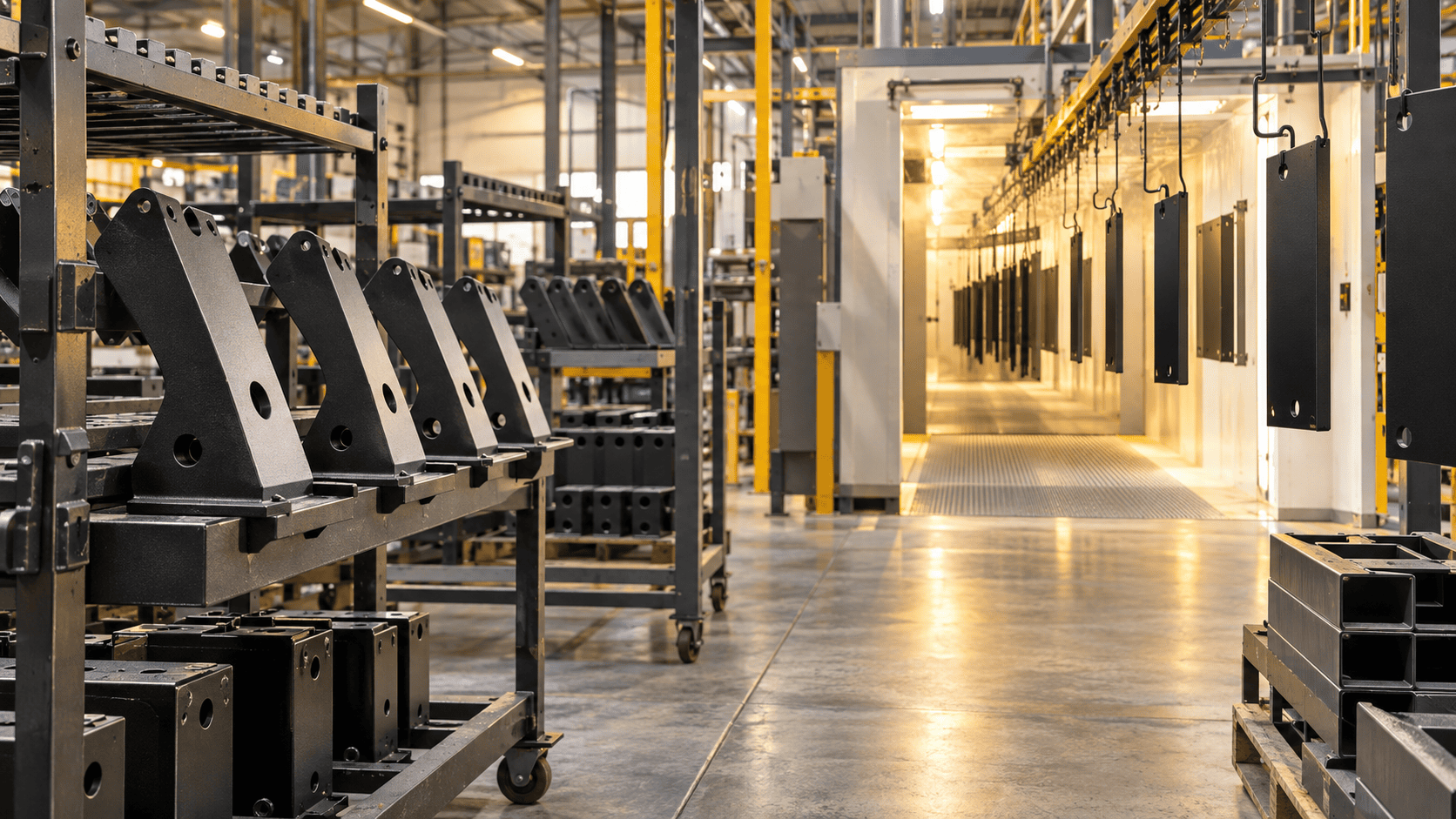
Domestic metal finishing can reduce supply-chain risk when the total cost of offshore processing—freight, delays, inventory, communication, tariffs, and recovery from problems—outweighs the apparent unit-price advantage. The right decision is not simply “overseas or domestic.” It is whether moving a specific finishing step closer to fabrication, assembly, or the customer will make the complete production plan more dependable.
That question matters to three kinds of manufacturers: U.S. companies reshoring work, international firms establishing U.S. production, and domestic manufacturers that need a more stable regional finishing partner.
Start With Landed Cost, Not Unit Price
An offshore coating price can look attractive until the comparison includes the full cost of getting conforming parts to the point of use. The National Institute of Standards and Technology’s Manufacturing Extension Partnership recommends evaluating reshoring decisions with total landed cost, including transportation, inventory, quality, late or canceled deliveries, and possible import tariffs—not purchase price alone.
For a metal-finishing program, the comparison should include:
- ocean, air, rail, and truck freight;
- customs handling and duties;
- inventory held to cover long or variable lead times;
- packaging and damage risk across multiple handoffs;
- rework, sorting, or replacement costs when parts do not meet requirements;
- engineering and management time spent resolving problems across time zones; and
- the production cost of a late or interrupted shipment.
This broader view does not automatically make domestic finishing the least expensive option. It makes the comparison honest.

Identify the Risks Domestic Finishing Can Actually Reduce
International shipping remains essential to manufacturing, but it can add variables that a buyer does not control. The United Nations Conference on Trade and Development reported continued freight-rate volatility and route disruption as vessels rerouted around conflict-affected shipping lanes. Port congestion, geopolitical instability, capacity constraints, and longer voyages can change both cost and delivery performance.
A qualified domestic finishing partner may reduce exposure by shortening transportation routes, eliminating ocean freight from the finishing step, reducing handoffs, and making the production team easier to reach when quantities, specifications, or schedules change. It can also make smaller and more frequent releases practical, reducing the need to hold months of finished inventory.
Domestic sourcing does not remove every risk. Raw material, fabricated components, coating materials, or other inputs may still come from outside the United States. The purpose is to reduce avoidable dependencies and improve control over the portion of the process that can be localized.
Evaluate the Finishing Step Before Moving It
A successful transition requires more than finding an available coating line. Before moving recurring work, manufacturers should answer seven questions:
- What is the actual finish specification? Identify the substrate, surface condition, pretreatment, coating type, color or approved standard, gloss, texture, film build, masking, and inspection requirements.
- Will the parts fit the equipment? Part dimensions, weight, hanging orientation, oven clearance, and handling needs determine whether the work fits the processor’s usable capacity.
- What quantities and release pattern are expected? Annual volume alone is not enough. Batch size, forecast visibility, surge demand, and required turnaround shape the production plan.
- What tooling is required? Reusable racks, hooks, jigs, plugs, caps, or custom fixtures may be needed for repeatability, drainage, coverage, and efficient loading.
- How will quality be approved? Define first-article samples, appearance limits, test requirements, acceptance records, and who has authority to approve a change.
- How will finished parts be protected? Packaging, separators, rack design, pickup frequency, and receiving practices should prevent finish damage after coating.
- How will the transition be staged? Pilot runs, overlapping supply, safety stock, and a controlled approval gate are safer than an abrupt all-at-once move.
Domestic Manufacturers Benefit, Too
Supply-chain support is not limited to companies bringing work back from overseas. A manufacturer already producing in the United States may still depend on a distant, overloaded, or poorly matched finisher. A capable regional partner can shorten routes, improve schedule visibility, provide a backup or alternate source, and respond more quickly to engineering changes or production problems.
The goal is not simply to replace one vendor with another. It is to build a finishing path around the manufacturer’s real release schedule, quality requirements, handling constraints, and continuity plan.
Treat Tariff Exposure as a Product-Specific Question
Reshoring a finishing operation or establishing U.S.-based processing may reduce tariff exposure in some supply chains, but it does not guarantee tariff relief. U.S. duty treatment depends on the product’s classification, country of origin, value, and the complete manufacturing process. U.S. Customs and Border Protection advises importers to determine the correct Harmonized Tariff Schedule classification and seek a binding ruling when certainty is needed.
Salt City Metal Coatings does not provide customs or legal advice. We can help determine whether domestic surface preparation and powder coating can be a practical part of a broader U.S. production plan. Importers and international manufacturers should confirm duty and origin treatment with a qualified customs professional.
What to Send for a Domestic-Finishing Review
To evaluate fit, send drawings or representative photos, substrate and finish specifications, expected quantities, release frequency, current sourcing path, target schedule, packaging requirements, and the supply-chain problem you are trying to solve. Include any known quality concerns, approval tests, masking requirements, or equipment constraints.
Important tariff and customs notice: Salt City Metal Coatings provides metal-finishing and production support—not legal, customs, tax, or financial advice. Tariff classification, duty exposure, country of origin, marking requirements, trade-program eligibility, and “Made in USA” claims depend on the specific product, transaction, manufacturing process, and current law. Confirm these matters with qualified customs, trade, legal, and tax professionals before making sourcing or investment decisions.
Salt City Metal Coatings supports manufacturers that are reshoring work, establishing U.S. finishing, or strengthening an existing domestic supply chain. Review our Supply Chain Support capabilities, then request a production review so we can determine whether the parts, process, and schedule are a responsible fit.