

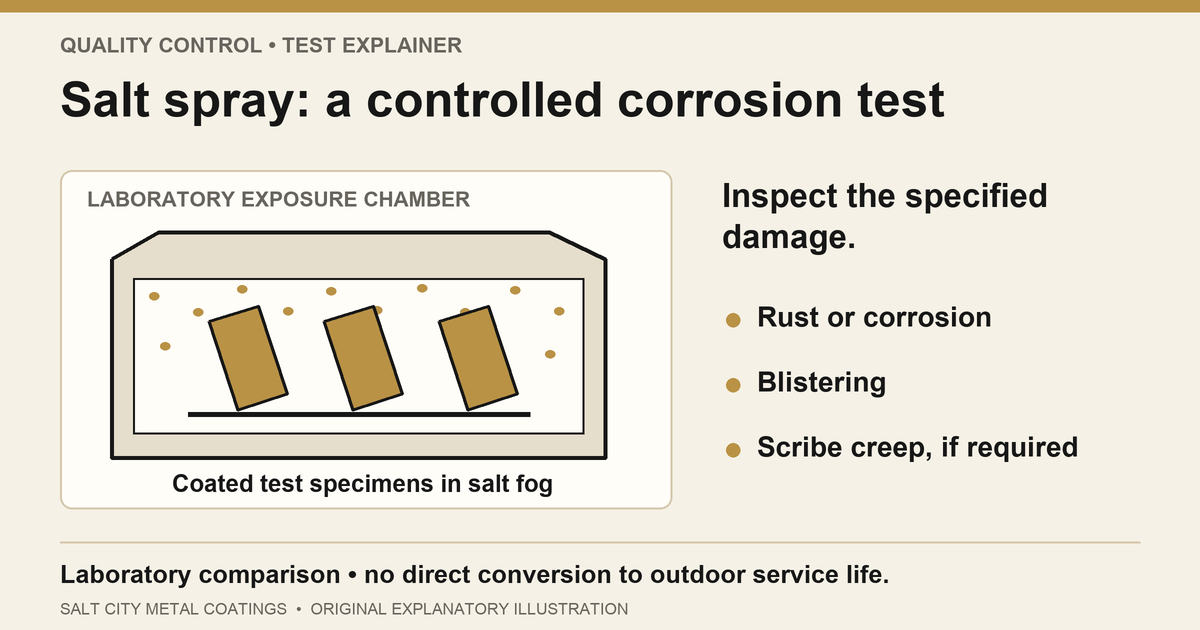
Salt-spray testing exposes specimens to a controlled corrosive fog to assess a coating system against an agreed requirement. It can reveal weaknesses and support quality checks. A result stated in chamber hours cannot be converted into a guaranteed number of years outdoors.
Before asking whether a finish “passes salt spray,” define what will be tested, for how long, and what condition counts as acceptable.
The exposure method is only part of the requirement
ASTM B117 is a practice for operating salt-spray apparatus. It defines the test environment, not a universal product exposure duration or interpretation of results. Saying “tested to B117” leaves important purchasing questions unanswered.
ISO 9227 covers neutral salt spray (NSS), acetic acid salt spray (AASS) and copper-accelerated acetic acid salt spray (CASS). These are different exposures, not interchangeable labels. ISO likewise leaves the specimen details, product exposure period and interpretation to the relevant specification.
Evaluation needs its own definition. For example, ASTM D1654 addresses coated specimens after corrosive exposure, including corrosion, blistering, loss of adhesion at a scribe and other film failure. The buyer’s governing specification must still establish the required duration and acceptable result.
Test the complete system
A powder’s name or color does not describe the whole specimen. The metal, surface preparation, pretreatment, primer if used, coating build and cure belong in the test record. Panel geometry, edges and intentional damage also need a defined treatment.
A scribe is a deliberate cut that exposes the substrate when the test plan calls for one. Agree whether samples are scribed, how edges are prepared or sealed, and which areas will be evaluated. A report of damage spreading from a scribe answers a different question from a general observation of an otherwise intact coated surface.
For repeat work, decide how sample panels represent production. Record the batch or process information needed to trace them. A flat coupon and a fabricated assembly should not silently become equivalent evidence for every edge, weld and recess.
What the results can—and cannot—tell you
Chamber testing is useful for controlled screening and checking consistency under a specified plan. Equipment manufacturer Q-Lab explains that conventional salt spray is not intended to accurately simulate most service environments or predict long-term corrosion performance.
ASTM cautions that natural exposure performance cannot generally be inferred from salt spray alone. ISO warns against using these tests to rank different materials for long-term corrosion resistance. Compare suitably matched systems under the same agreed conditions, with enough specimens to understand variation. A longer exposure result is not automatically a longer-life warranty.
For a product facing changing wet/dry conditions, sunlight or other stresses, ask the coating supplier or testing laboratory whether the customer specification calls for cyclic corrosion, weathering or additional tests. Choose the test to answer the service question rather than chasing an isolated hour count.
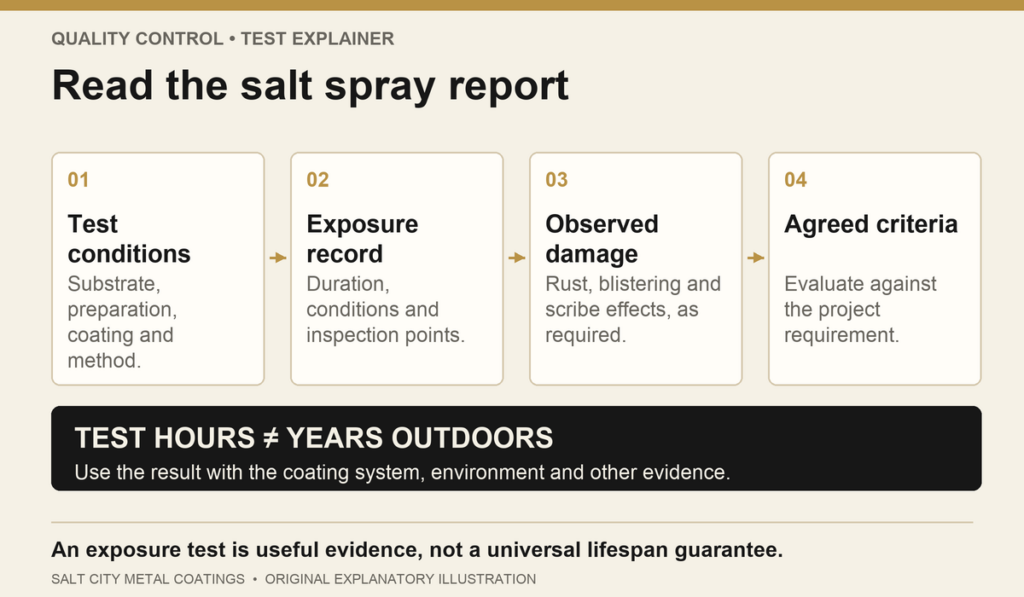
Where testing happens, and what to request
Salt-spray exposure takes place in a controlled corrosion-testing laboratory. At customer request, Salt City has this testing performed at an outside lab to help validate agreed coating protocols. Testing may involve additional cost. It provides evidence about the tested protocol, not a guarantee of a passing result or field performance.
If your contract requires accredited testing, check that the laboratory’s ISO/IEC 17025 accreditation scope covers the required work. A2LA explains why the specific scope matters; a general accreditation statement alone does not cover every capability.
When you request a quote, include the method and edition, substrate/preparation/coating system, sample quantity, scribe and edge requirements, duration, evaluation criteria and required report. Ask Salt City to review the agreed testing protocol, outside-lab report requirements and any added testing charges before production.