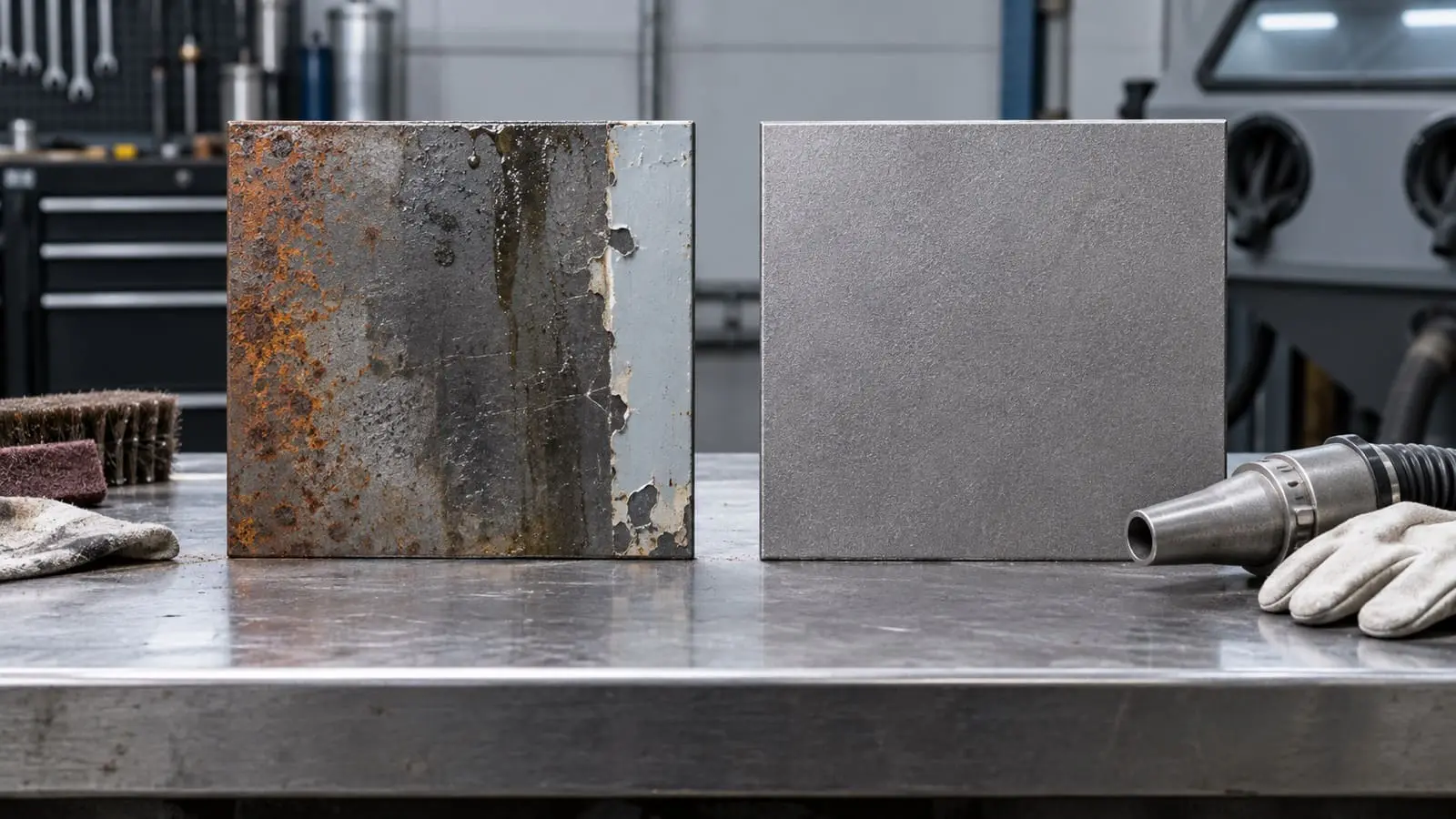
Powder coating is the visible finish, but its performance begins with the metal underneath. Oil, rust, mill scale, old coating, shop dust, and other contamination can interfere with adhesion and appearance. Surface preparation removes or controls those conditions and prepares the substrate for the selected coating system.
The practical rule is simple: choose preparation for the actual metal, contamination, geometry, and service conditions. One process should not be assumed to fit every job.
Cleaning and profiling solve different problems
Cleaning targets soils such as oil, grease, dust, and process residue. Mechanical preparation can remove rust, scale, or an old finish and may create a surface profile that supports coating adhesion. Chemical pretreatment can prepare the substrate and improve the coating system’s performance. These steps may be used in different combinations.
The Powder Coating Institute defines pretreatment as preparing a part to improve adhesion and corrosion resistance. Its technical FAQ also explains that cleaner choice and pretreatment depend on the substrate and the soils present.
Why the starting surface changes the plan
A new steel fabrication may carry mill scale, cutting fluid, fingerprints, or weld residue. An older part may have rust, several paint layers, or repairs hidden under the finish. Aluminum and galvanized surfaces require their own review. A process that is appropriate for one substrate or condition can be wrong for another.
Geometry matters too. Deep recesses, overlapping seams, tubes, welded corners, and assembled parts can trap contamination or make preparation difficult. Send photos of hidden areas and explain whether the part can be disassembled.
Preparation affects both appearance and performance
Powder coating follows the shape and condition of the substrate. It does not reliably erase deep pits, rough welds, grind marks, dents, or uneven repairs. A textured finish may change what the eye notices, but it should not be used as a substitute for needed metalwork or surface preparation.
Performance also depends on the complete system: substrate, preparation, pretreatment when used, powder chemistry, application, cure, film thickness, design, and exposure. The Powder Coating Institute’s pretreatment and corrosion overview stresses matching the substrate, soils, pretreatment, and powder system to the desired performance.
What to tell the coating shop
- metal type, dimensions, and quantity;
- whether the part is new, used, repaired, or previously coated;
- known contamination, rust, scale, or old finishes;
- clear photos of edges, welds, corners, recesses, and damaged areas;
- indoor, outdoor, or other service conditions;
- appearance and performance expectations; and
- surfaces that must stay uncoated or maintain a precise fit.
Salt City Metal Coatings offers surface-preparation and media-blasting services for appropriate projects. Send photos and project details for review. We can discuss preparation as part of the complete coating plan for your actual parts.